
A Growing Number of Investors Are Sharing Their Voting for Sustainability Results to Demonstrate Stewardship Leadership
In the two years since we founded rezonanz, transparency in stewardship has taken a meaningful step forward.
With the release of rezonanz’s Voting for Sustainability ranking, institutional investors have access to a quantitative benchmark showing how their proxy voting aligns with sustainability: measured relative to hundreds of global peers.
We are now seeing the next step in that evolution: investors themselves are beginning to communicate their results publicly.
From internal benchmarking to external signaling
Traditionally, stewardship disclosures have focused on process: policies, principles, and high-level statistics such as support rates on shareholder proposals or votes cast against management.
While useful, these metrics often miss a critical question:
How does an investor’s stewardship approach compare to the broader market?
The Voting for Sustainability ranking addresses this gap by benchmarking investors against a global universe of over 400 institutions and prioritizing the most decision-relevant votes. It offers an outside-in view of how consistently investors use their voting power to support sustainability outcomes.
What was once primarily an internal benchmarking tool is now becoming a clear external signal of stewardship positioning. This shift is relevant not only for asset managers, but also for asset owners seeking greater oversight of delegated voting.
Early adopters are setting the tone
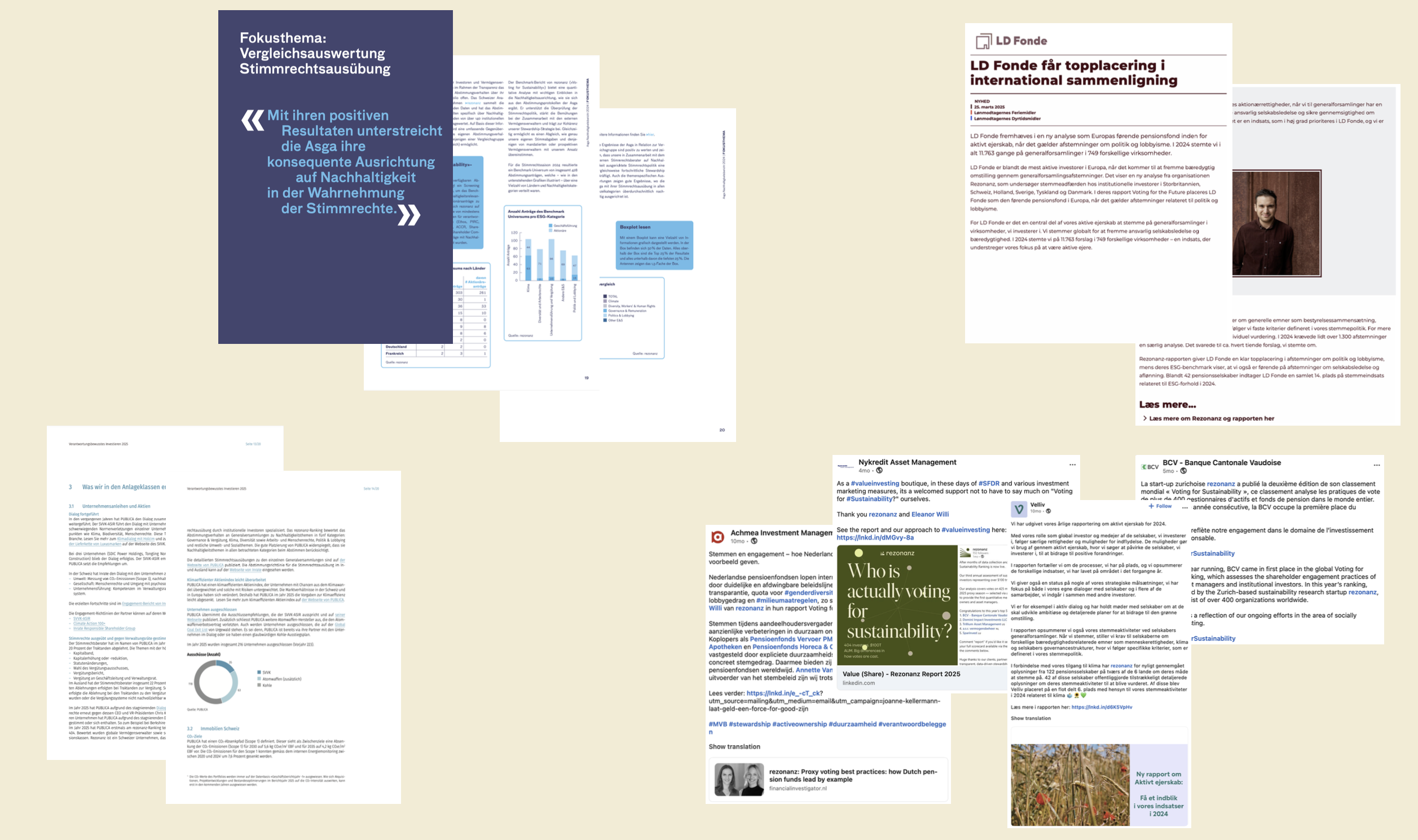
Several leading asset managers and asset owners have already begun referencing their results publicly, integrating them into broader stewardship communication. These examples span formats and geographies:
Sustainability reporting
- ASGA Pensionskasse (CH) featured its ranking in its sustainability report, embedding voting performance directly within its broader ESG disclosure.
- Publica (CH), one of Switzerland’s largest pension funds, referenced its rezonanz ranking in its 2025 responsible investment report, noting its placement (44th out of 404 investors) and using the ranking as an external benchmark to contextualize its votingout alacross key sustainability themes such as climate, human rights, and political engagement.
Blog and long-form content
- LD Fonde (DK) published a blog post highlighting its strong placement, linking voting behavior to its approach on political engagement and lobbying.
LinkedIn and public updates
- Banque Cantonale Vaudoise (CH) shared its ranking as part of its stewardship communication.
- Velliv (DK) highlighted its performance on climate-related voting.
- Achmea (NL) referenced results across multiple pension fund clients in a post, including Pensioenfonds Vervoer, PMA, Pensioenfonds Medewerkers Apotheken, and Pensioenfonds Horeca & Catering
- Nykredit Asset Management (DK) emphasized how the ranking supports its positioning as a value investing boutique in a special feature, noting that external validation reduces the need for self-assertion on sustainability alignment.
Together, these examples reflect a broader trend: investors are increasingly willing to show how their actions compare not just what they do.
Why this matters now
This growing openness comes at a pivotal moment. Historically, many investors have relied on third-party assessments (such as ShareAction’s Voting Matters) as important reference points for stewardship performance. These initiatives have played a critical role in advancing industry-wide transparency and accountability.
As the stewardship landscape continues to evolve, there is growing demand for complementary perspectives and methodologies that can provide additional depth, comparability, and global coverage.
The Voting for Sustainability ranking contributes to this by:
- Covering a broad global investor universe
- Focusing on the most pivotal sustainability-related votes
- Providing a consistent, comparative peer benchmark
This broader coverage enables more investors, both asset managers and asset owners, to articulate their stewardship positioning more clearly and credibly.
A new layer of accountability and opportunity
Publicly communicating voting performance is more than a reputational exercise. It introduces a new layer of accountability, allowing stakeholders (including clients, beneficiaries, and civil society) to better understand how investors are using their influence.
Importantly, it also strengthens the role of asset owners. By providing a comparable external benchmark, the ranking enables asset owners to assess whether their asset managers’ voting aligns with their sustainability expectations and to support more informed engagement where it does not.
At the same time, it creates a clear opportunity. For investors that perform well, referencing independent benchmarking can:
- Reinforce credibility
- Differentiate their stewardship approach
- Translate complex voting data into a clear narrative
All without relying solely on self-defined metrics.
The examples highlighted above are still early signals, but they point toward a broader shift. Voting for Sustainability is not only a measurement tool: our goal is to make it part of how stewardship is communicated.
Explore your own positioning
For investors already disclosing their voting record:
→ Register to access your 2025 ranking and understand how your voting compares across the global universe
For those not yet disclosing in detail:
→ Download the full report to explore the methodology and results
As stewardship expectations continue to evolve, the ability to demonstrate sustainability alignment will only grow in importance.
Latest articles


amplifying investors' voices to enable better decisions